Honors Study Abroad Scholarship SPM 399 – Global Sport Management
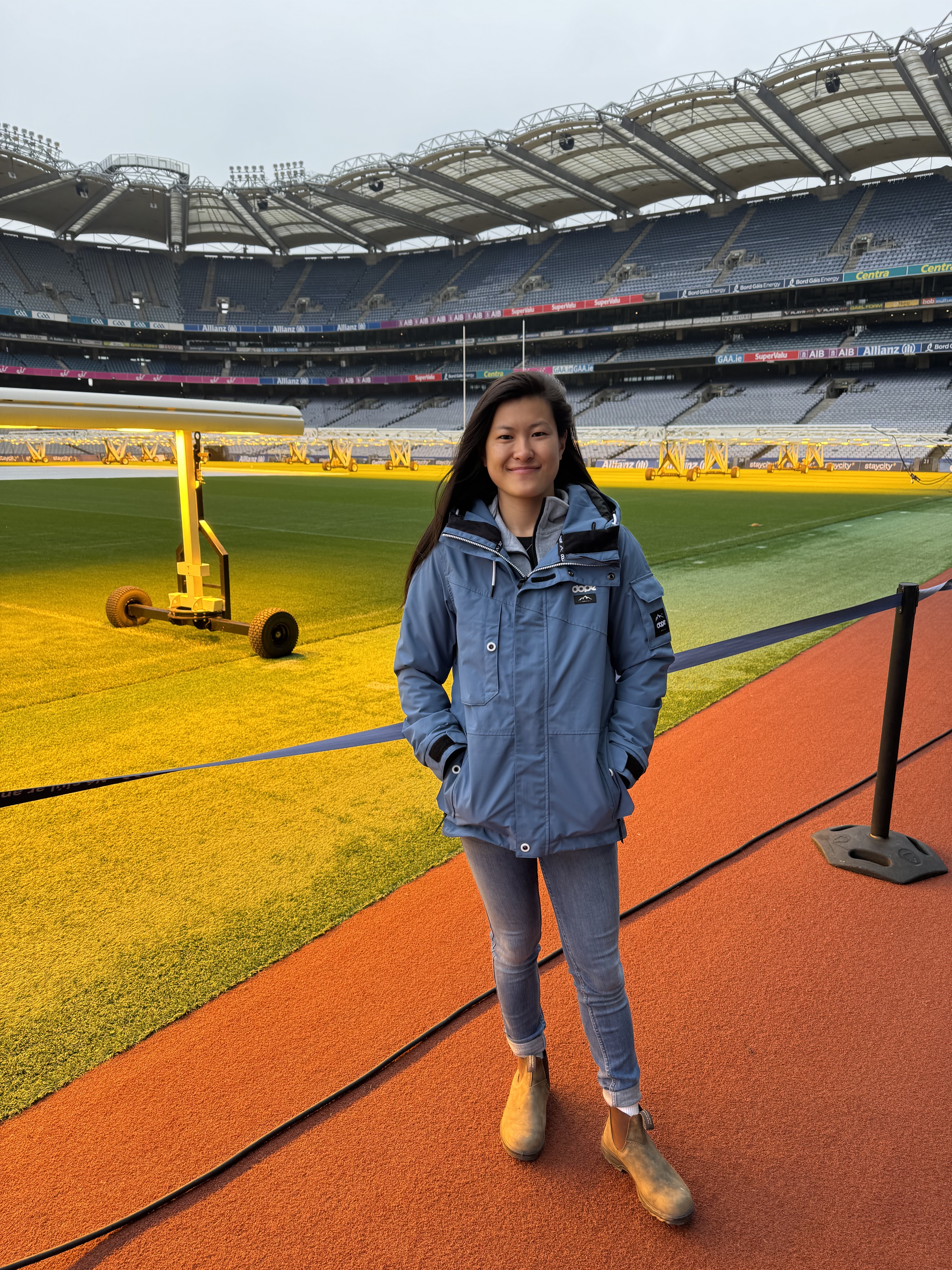
Over spring break, I had the opportunity to travel to Ireland as a part of SPM 399: Global Sport Management. This was a great experience to explore and learn about the culture of Ireland as well as how the sports industry functions abroad.
We started the trip in the town of Donegal. There, we saw beautiful countryside and Arranmore Island. My favorite part of the first half of the trip was surfing in Bundoran, the surf capital of Ireland. I never imagined I would be able to say I’ve been surfing in Ireland, but here we are, and although it was freezing, it ended up being so much fun! It was great to experience the nation outside of Dublin to get a real feel of what life is like there.
While in Dublin, we were exposed to many athletic facilities, such as Sport Ireland Campus, which is home to Ireland’s national teams and Croke Park, which is a historic landmark of the Gaelic Athletic Association (GAA). Being able to immerse myself in the Irish culture and sports scene was fascinating. I want to work in football (soccer) in the future, so this was a great opportunity to learn about and immerse myself in a country where the sport is more popular. In addition to football, the nation prides itself with the GAA and rugby, which we got to experience both games. In Donegal, we went to a Gaelic football match. This was a unique experience compared to American sporting events – especially considering it is an amateur league and the athletes are unpaid. As for the rugby game, we watched Ireland face off against their rivals to the east, England. We watched this at a pub, since it is far more common than house viewing parties that we might see during the Super Bowl, for example. The atmosphere during the game was like nothing else I have seen before – everyone was so passionate and invested.
Overall, this was an eye-opening experience about what sport is like outside of the US. It was a great chance to see athletics abroad and the various international career options. I would like to thank the UT Honors Program for aiding this opportunity. It is something I will never forget!
Every semester, Honors features an event called a “coffee conversation” where professors talk about issues in the day’s headlines or deep dive into their area of expertise and host a conversation, rather than a lecture, about that subject. This week’s guiding question was “How do we get from the page to the screen?” and was led by Professor Taylor Raye Curry, professor of film at UT. Her area of specialty is narrative film production. The clip she showed was from her production, “7 1/2 minutes,” which is under consideration at several film festivals. Students talked about not only film production but how to set up resources for time management and how to edit broader projects (which all students have to undertake via the thesis) to make them feasible.
These past few weeks at Oxford have provided some of the most inspiring and captivating experiences of my life. I have had the incredible and unique opportunity to explore topics such as cross-cultural cognitive psychology and the psychology of climate change with my two fantastic tutors. The remarkable flexibility of Oxford’s tutorial system and intimacy of the one-on-one sessions provides an exceptional environment to pursue my personal interests, uninhibited by a specific curriculum. It has been a great pleasure to meet and develop friendships with members of the Oxford Study Abroad Programme (OSAP) cohort, as well as full-time Oxford students from my college, Oriel, and beyond.
I have been fortunate to work with Dr. Carmen Pinon, a lecturer in neuroscience, for my tutorial in cross-cultural psychology. Beginning with an exploration of subjects relating to one’s sense of self in individualist vs collectivist cultures, I analyzed how these differences relate to distinct patterns of social interactions within each group. In the subsequent weeks, I have delved into the developmental cognitive processes underlying such distinct social behavior, comparing and contrasting the ways in which children from different cultures acquire verbal, motor, and executive functioning skills. Further examination of topics such as mechanisms of chemosignaling has expanded my acumen in biopsychology and allowed for greater appreciation and insight into the physiology underpinning social behavior and emotional exchange. It has been immensely rewarding to broaden my understanding of psychology beyond the confines of the predominantly WEIRD (western, educated, industrialized, rich, and democratic) participants and research findings typically favored in psychological pursuits, instead elucidating more nuanced and often overlooked demographic and cultural psychologies.
My other tutorial encompasses a variety of topics pertaining to the ongoing climate crisis and the plethora of experiences with, attitudes towards, and behaviors resulting from such through a psychological lens. My tutor Dr. Ariell Ahearn and I both hail from New York and quickly developed a conversational rapport- it has been a true privilege to work with her. Echoing some of the ideas discussed in Honors 240 “Where Are We Going?”, my immersion into the area began with critically examining the ways in which we, as humans, define, relate to, and romanticize nature and wilderness. We have since discussed in great depth the notion of solastalgia, a term coined to describe the lived experience of climate change and the distress resulting from the experience of geographic degradation as a result of such. Applying critical social psychology theory, which emphasizes societally rather than individually-focused approaches to sustainable behavior and underscores the responsibility of capitalism and colonialism in contributing to global warming, has accompanied insights on how populations who have contributed the least to climate change are now facing the brunt of its effects. Dr. Ahearn, whose specialization is in Mongolian pastoralist communities, has been instrumental in introducing perspectives of diverse populations from around the globe, an endeavor which compliments my studies in cross-cultural psychology. Ultimately, I intend to use the knowledge gleaned from this tutorial to inform my senior thesis, which will focus on assessment of the psychological impacts of climate change.
Outside of my studies, I spend lots of time with my roommates and peers from OSAP and Oxford. I have yet to go a weekend without traveling: between OSAP-sponsored trips every other week, I have visited London a handful of times, enjoyed a day trip to Bath to view the ancient roman ruins, and even squeezed in a trip to Aix-en-Provence. My friends and I frequent Oxford’s board games cafe, Jericho’s historic Phoenix Picturehouse, and have tried our hand at a few quiz nights at the local pubs. I am a great fan of Oxford’s many museums (all of which boast free admission), though partial to the Ashmolean for its fantastic and awe-inspiring landscape galleries. At least once a week I will attend a formal dinner at Oriel, Trinity, or New College, as these provide opportunities to get dressed up, meet new people, and- perhaps most importantly- enjoy an often delicious three-course meal for just under £9. I have found that attending lectures affords an additional avenue for creating inroads with Oxford students as well as expanding my scope of knowledge beyond what I am learning in my tutorials- my favorite of these series has been Dr. Robert Hepach’s talks on developmental psychology. One of the things I love most about Oxford is the conviviality of the city and community; the atmosphere both on and off campus is truly enchanting.
I am incredibly grateful to UT and the honors program for allowing me this extraordinary opportunity to learn, explore, and grow both as an academic and a young adult. My time at Oxford has been nothing short of life-changing and will no doubt remain a most cherished experience. While I will be reluctant to leave, I am eager to return to UT where I may continue to find passion and inspiration in my intellectual pursuits, guided and informed by the interests cultivated over these past few weeks.